
Licking Projected and Actual Release
A projected date estimates when custody may end under the current sentence and known credits. Actual release is the recorded departure event. The Sheriff's active list may show a Release Date while the person remains housed, so the field stays prospective until the Jail Division confirms departure. A value of TBD means no public date is available. Neither field proves release to the community because transfer to ODRC, another county, treatment, or another holder remains possible.
Scheduled vs actual: Record the displayed date and retrieval time, then confirm the release transaction and destination with the current custodian.
Pretrial custody follows bond and court orders rather than a sentence calculation. A sentenced term has a legal starting point, but amended judgments, certified jail credit, and lawful administrative action may change the result.
Find a Licking Projected Release Date
The correct route turns on the custodian. The active county roster is about people still housed locally. ODRC covers state prisoners, Department supervision, and judicial release, but not each person who left a county jail.
- Use the booking docket to identify the court, sentence, and current custodian.
- For county custody, read the Sheriff's Release Date or TBD field, then call the Jail Division and check the signed court entry.
- For state custody, search the ODRC Offender Search by offender number or a modest name query.
- Match the ODRC number, committing county, and docket. Read the status and Expected Release Date/Parole Eligibility Date label exactly.
- Check holders, later court entries, and supervision. Reconfirm close to the planned date.
The Licking County released inmate record path explains how to verify an actual county departure after a projected date passes.
Licking Release Date Computation
State computation begins with the signed judgment: offense date, definite or indefinite term, mandatory terms, concurrent or consecutive structure, and jail-time credit. ORC 2967.191 governs qualifying confinement credit. Sentencing-era rules differ, and OAC 5120-2-03.2 addresses calculation across major Ohio sentencing eras.
For qualifying people governed on and after April 4, 2024, ORC 2967.194 and OAC 5120-2-06 provide earned-credit rules with exclusions, rates, limits, and withdrawal provisions. No universal Ohio rule requires every inmate to serve about 85 percent. Mandatory terms, parole statutes, judicial release, and indefinite sentences differ.
Note: A calculator cannot replace ODRC's sentence computation because the judgment, offense date, eligibility rules, and later credits control.
Why Licking Release Dates Change
A date can move for a lawful reason without making the earlier display false. The key is to identify which office changed which input.
| Factor | Effect to verify |
|---|---|
| Corrected judgment or jail credit | The court and ODRC may recompute the term. |
| Earned credit award or loss | An eligible state date may move under current rules. |
| Holder, warrant, or new charge | Release from one case may become continued custody or transfer. |
| Judicial release | A court order may change prison custody to supervised release. |
| Parole result | Eligibility, grant, and physical release remain separate stages. |
| Indefinite-sentence finding | ORC 2967.271 may allow continued incarceration up to the maximum. |
Local jail reductions are separate. ORC 2947.151 permits a potential reduction for a qualifying misdemeanor jail term under stated conduct or program conditions. It is not automatic credit for every county inmate.
Licking ODRC Date Field
ODRC's exact label is Expected Release Date/Parole Eligibility Date. The slash is crucial. For one sentence it may indicate an expected expiration or release calculation. For a parole-eligible sentence it can mark eligibility for Board consideration, not a promise of release.
Read the official ODRC date definitions before viewing the captured field explanation.
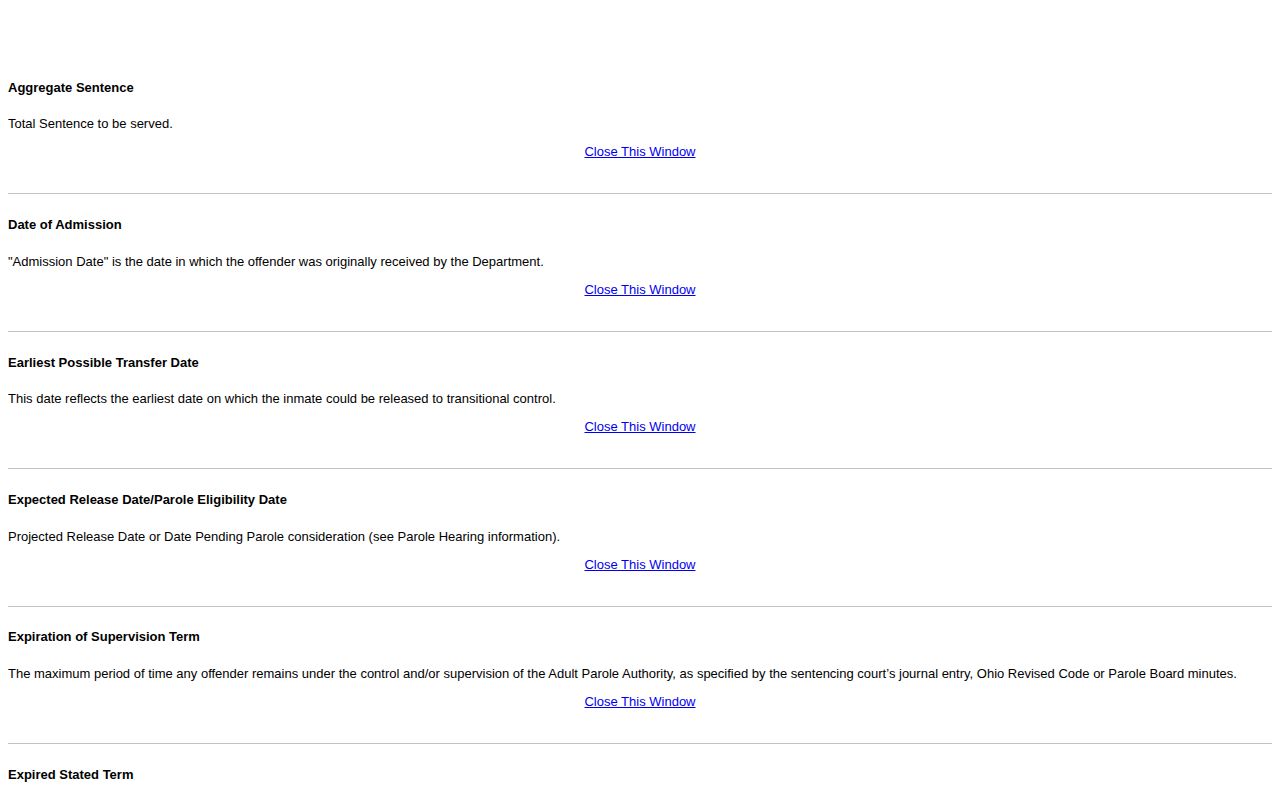
The screenshot supports reading the combined label in the context of the person's sentence and status.
Never Merge Licking Release Dates
The Sheriff's active roster can publish a future Release Date or TBD for a person still housed. ODRC uses the combined expected-release or parole-eligibility label for a state record. These are separate systems and separate legal stages.
A Licking County defendant transferred to state prison is not a community release. Once ODRC takes custody, its computation becomes the main state source. If the person later receives judicial release, parole, expiration, or discharge, read the status mechanism and supervision fields rather than carrying forward the old county date.
Confirm Licking County Release Dates
For a county sentence, call the Jail Division at 740-670-5501 and review the court's signed entry. For a release record, Civil/Records can be reached at 740-670-5541. Ask whether the departure was to the community or another custodian.
For a state sentence, check the live ODRC detail and definitions, then review later court action. A VINELink Inmate Search alert can report a participating custody event, but it is not a certified discharge record and may reflect transfer rather than freedom.
Note: Preserve the date, exact field label, status, and retrieval time so a later change can be reconciled accurately.
Licking Court Sentence Inputs
The signed judgment supplies the legal inputs that a web date cannot explain by itself. Check the offense date, each count, definite or indefinite form, minimum and maximum terms, mandatory specifications, and whether terms run at the same time or one after another. Jail-time credit should appear in the court record and ODRC sentence information when applicable. If those records differ, obtain the signed entry and any corrected entry rather than choosing the most convenient date.
Judicial release under ORC 2929.20 is court action, not routine earned credit. Its eighty-percent qualifying recommendation mechanism applies only within defined terms and still requires a court decision. Parole eligibility under ORC 2967.13 is another distinct route. Modern qualifying indefinite terms use the presumptive-release framework in ORC 2967.271. These paths cannot be reduced to one percentage.
Licking Parole Eligibility Dates
A parole-eligibility date marks when consideration may occur under the governing sentence. It is not a hearing result or gate date. The Ohio Parole Board may schedule, continue, deny, or grant a matter. Even a grant can precede an effective date, plan approval, detainer review, or later rescission. For that reason, the ODRC field should be paired with hearing information and the latest custody status.
Record the ODRC number before searching Board information. A name alone can match more than one person. Check the Next Parole Board Hearing or Review Month and the latest result wording when shown. If an abbreviation is unclear, seek the eligible decision sheet or minutes and preserve the official wording. Then return to the live ODRC detail to see whether custody actually changed.
Licking County Holds and Transfers
A hold can prevent release to the community even when one sentence or charge ends. The active jail list may identify an APA holder or another county. State records may also reflect institutional or legal holds. The records must be reconciled with every case and agency named in the booking.
Transfer is a custody change. A person sent from the Justice Center to ODRC has left the county jail but has not been released from confinement. The former county date should not be used as the state release date. Likewise, departure from ODRC does not prove that a federal, immigration, or local holder did not take custody.
A sound confirmation asks for actual date and time, release authority or type, and destination if recorded and public. This separates bond, sentence completion, judicial release, parole, and transfer. It also explains why a roster disappearance cannot answer when the person reached the community.
Recheck Licking Release Calculations
Recheck the source near the anticipated date because sentence data can change. Save the displayed field label and observation time, not just a date copied into a note. Review later court entries for appeals, corrected credit, judicial release, or new sanctions. A fresh ODRC detail is more reliable than an old screenshot for current status.
If the county roster shows TBD, do not estimate. If it shows a future date, treat it as planned while the person remains active. Ask the Jail Division whether another hold or destination applies. If ODRC shows the combined expected-release or parole-eligibility label, read the definition for the sentence type. This measured process takes longer than a single search but avoids turning a projected date into a false statement of release.
Resolve Licking Release Date Conflicts
Two dates may describe different events rather than a true error. A court entry sets or changes the legal sentence. The Justice Center field reflects county custody planning. ODRC computes a state term from the judgment, jail-time credit, governing statutes, and later Department decisions. A Parole Board date may mark eligibility or review. VINE reports a participating agency's custody event. None should be silently substituted for another.
When sources disagree, copy the exact label, status, docket, offender or booking number, and retrieval time from each source. Obtain the signed judgment and any corrected entry. Ask the current custodian which date it is using and whether a holder, transfer, or pending court action remains. If the issue concerns an ODRC calculation, identify the offender number and sentence entry when contacting the Department. For a county date, ask the Jail Division whether it is planned, confirmed, or no longer current.
The final confirmation comes after the event. A county jail release transaction should show the actual departure and destination. A state record should be reread for the precise released or supervised status. Keeping the legal date, projected date, eligibility date, notification time, and actual release time separate prevents a reasonable estimate from becoming a false claim.
A negative result needs the same care. No date on the roster may mean “TBD,” a pretrial case, a data gap, or a different custodian. No ODRC match may mean the person never entered state custody or that the query was too narrow. Record what was searched, loosen an overfilled name query, verify identifiers, and then use the court and responsible records office. Do not create a date when the official record does not supply one.