
Licking County Parole or Probation
Physical release does not identify the kind of supervision that follows. Licking County Adult Court Services handles felony community control and certain pretrial supervision under Common Pleas orders. The Ohio Adult Parole Authority, within the Ohio Department of Rehabilitation and Correction, handles parole and post-release control after a state prison term. Municipal probation can continue in a Newark Municipal Court misdemeanor case. The signed court entry and exact ODRC status provide the sound starting point.
| Supervision | Authority | Best verification record |
|---|---|---|
| Community control or county probation | Licking County court and Adult Court Services | Signed sentencing or supervision entry |
| Parole | Ohio APA and Parole Board | ODRC detail, hearing result, and APA confirmation |
| Post-release control | Ohio APA | ODRC supervision fields and sentencing entry |
| Pretrial release | Controlling court | Bond order and current docket |
Parole applies to parole-eligible sentences and requires a Board decision. Post-release control is a distinct state supervision term tied to specified prison sentences. Probation is common shorthand for local court supervision, while Ohio felony courts use the term community control. Bond comes before final disposition and may carry monitoring, but it is not parole.
- Absconder
- A supervised person whom the agency alleges cannot be located or has failed to comply.
- Discharge
- The formal end of custody or supervision, not merely the day a jail door opens.
- Holder
- A request or authority that can keep a person in custody for another case or agency.
- Community control
- A felony sanction served under a court order in the community instead of prison.
Check Licking County Post-Release Supervision
Start with custody type, not a guess about the word probation. A Justice Center booking number and docket can point to the court. An ODRC number points to state prison or state supervision. The ODRC Offender Search covers current prisoners, people under Department supervision, and judicially released people, but it does not cover every county-jail release.
- Match the full name, case number, and court. Read the signed judgment for community control, probation, prison, or bond terms.
- If an ODRC number exists, open the state detail and verify the committing county, docket, release mechanism, and supervision fields.
- Route a Common Pleas community-control case to Adult Court Services. Route parole or post-release control to Ohio APA.
- Check later docket entries for violations, warrants, termination, or discharge. Do not rely on a cached summary.
- When records conflict, ask the named agency to confirm current status and the controlling order.
A released result and a supervision result can appear together. That means prison or jail custody ended while legal supervision continued. The broader Licking County released inmate search and records path helps separate a county release from a transfer or state discharge.
Note: A missing name on the active jail list proves neither discharge from supervision nor freedom from another agency's hold.
Licking County Probation Office Route
The local office is appropriate only when a Common Pleas order places the person on county community control or pretrial supervision. Its scope differs from Ohio APA. Confirm the case and judge before calling, then provide the case number rather than asking the office to infer supervision from an old jail entry.
The official Adult Court Services page describes felony community control, pretrial work, Day Reporting, and specialized interventions. Ohio APA assignments can change, so use the live ODRC contact directory rather than treating the county office as a state parole office.
The official Adult Court Services page can be reviewed in this captured view.
Open the Licking County Adult Court Services source before viewing the local supervision screenshot.
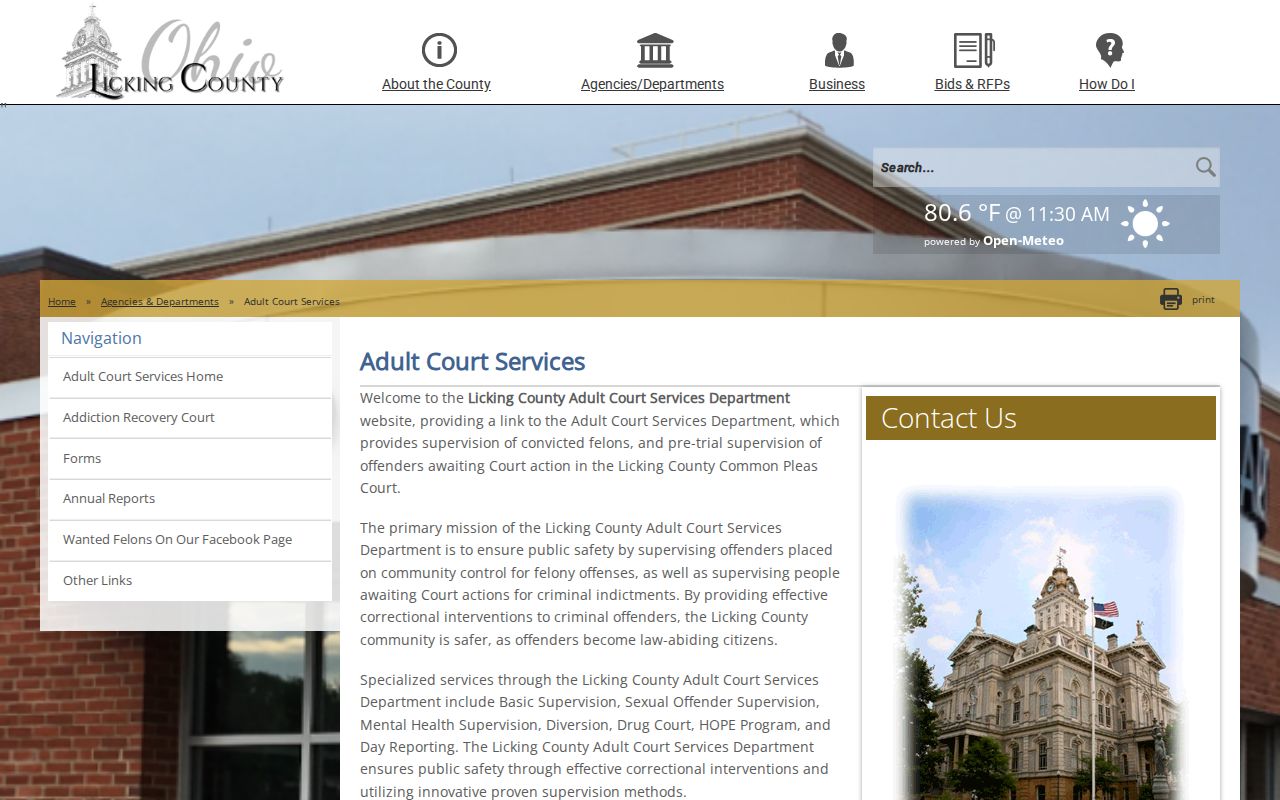
The image confirms the county office's local scope and contact path, which should not be confused with Ohio APA supervision.
Licking County Supervision Violations
Conditions come from the court order or state supervision authority. A claimed violation can lead to a hearing, sanction, warrant, or renewed custody, but it is not a new conviction by itself. Likewise, an absconder label means the agency alleges noncompliance or cannot locate the person. Verify the current docket and agency record before treating any label as current.
The active roster may show a holder tied to Ohio APA or another county. A holder means another authority may keep custody after a local count is resolved. VINE can send participating custody-event notices, but it is not a certified supervision record. A release alert may describe movement from one custodian without resolving the holder.
Licking County Parole Hearing Records
The Ohio Parole Board handles parole-eligible cases. In the official monthly search, the Next Parole Board Hearing Date filter accepts a year and month. The result is a live schedule, not a list of approved releases. A matter may be continued, changed, denied, or granted subject to later steps.
Individual ODRC detail can show the next hearing or review month and the latest hearing or review type and result. A favorable result still does not prove physical release because an effective date, approved plan, detainer, or rescission can intervene. Under Ohio Administrative Code Rule 5120:1-1-36, a focused records request can seek eligible decision sheets or minutes while protected material remains withheld.
See the official ODRC hearing-month filter before reviewing its captured interface.
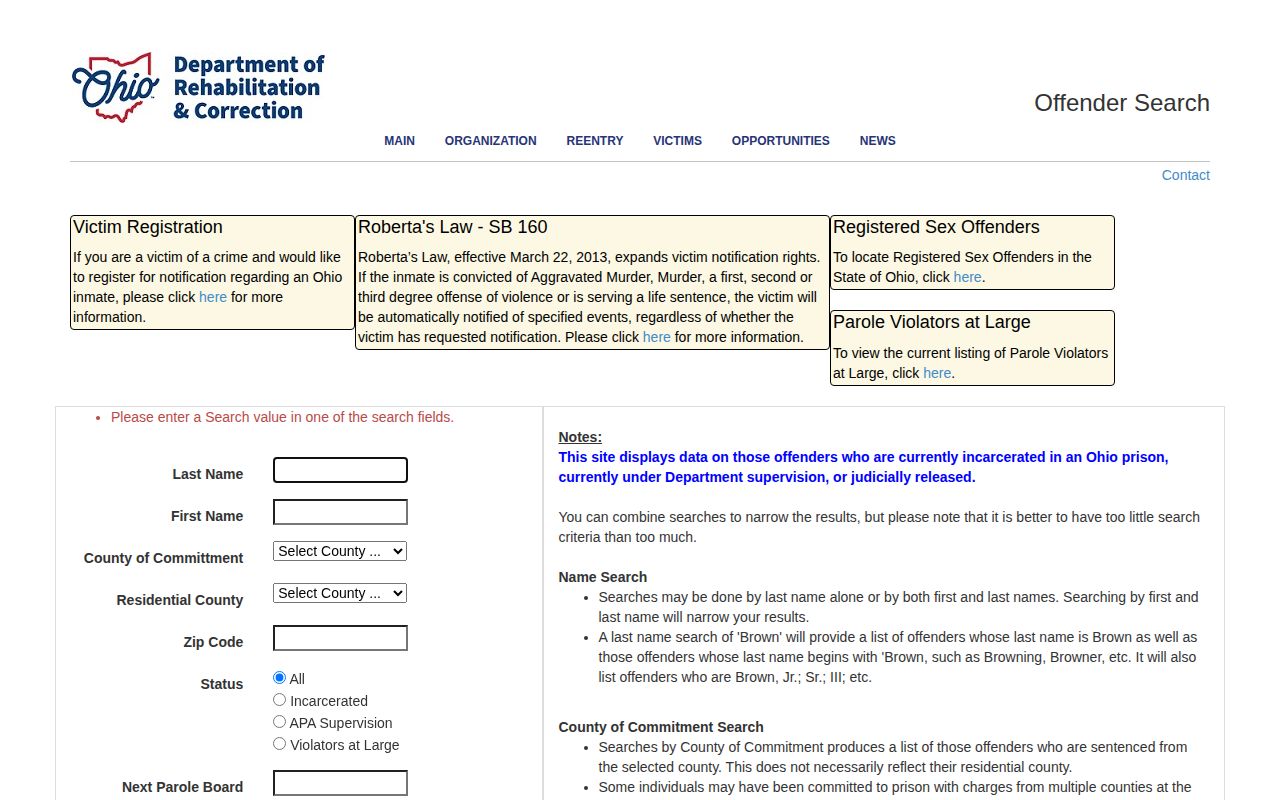
The screenshot shows why a monthly filter must be rerun: it is a search field, not a fixed release calendar.
Licking County Day Reporting Options
Licking County Adult Court Services operates a Day Reporting Program and specialized supervision or intervention functions. These are tied to local court supervision. They are not Ohio APA parole and do not prove that a person finished a state prison term.
Read the Common Pleas entry to learn whether the court imposed community control and which local requirements apply. Then use Adult Court Services for that lane. If ODRC shows parole or post-release control, the state lane remains separate even when both records involve the same Licking County case.
Note: A program name describes the local supervision route; only the controlling order establishes an individual's actual terms and status.
Property After a Licking Release
A former Licking County Justice Center inmate may log into SmartInmate with the inmate number and password to download that person's photos, messages, and postal mail without charge. This is personal content recovery after release. It is not a public inmate lookup, probation record, or booking-photo archive.
The Sheriff's jail information page documents the narrow process. A person who needs supervision proof should still use the court entry, ODRC record, or named supervising agency. Keeping the two tasks apart prevents private communications from being mistaken for a public correctional record.
Licking County APA Holder Warning
The Licking County active jail list can expressly show an APA HOLDER or a holder from another county. A charge-level disposition may also end with the word release. Those two facts can coexist. The charge may have been resolved while the person remains held for the other authority.
An APA hold should be checked with ODRC and the supervising authority. An outside-county hold belongs to the named county. A transfer is not release to the community, even when the person disappears from Licking County's roster.
Licking County Supervision Discharge
Supervision ends through the record made by the authority that imposed it. A county court can terminate community control. ODRC may show a supervision termination or maximum date for state control. The prison release date and the supervision discharge date are separate events, so both should be recorded when available.
Ohio public-record law does not open every probation or parole proceeding. Ohio Revised Code section 149.43 contains exclusions, including protected probation or parole material. Ask for the public status or final order, request segregable nonexempt portions, and use the exact agency wording. A termination entry is stronger proof than silence in an online portal.
Verify Licking Supervision Records
Verification is strongest when records are read in sequence. First establish the physical custody event. Next identify the sentence or bond order. Then identify the agency with legal authority after release. Finally, look for a later termination, violation, or discharge entry. Each source has limits. The jail roster describes active local custody, the court docket records judicial action, ODRC records state custody and supervision, and Adult Court Services handles its assigned county cases.
Use exact labels. Eligible for parole does not mean granted. Granted does not mean physically released. Released from prison does not mean discharged from APA supervision. A county charge marked release does not resolve an APA or outside-county holder. These distinctions are especially important in Licking County because several authorities can appear within one booking.
When a public summary is unclear, request the signed journal entry or eligible final agency record. Provide the case or offender number and date. Narrow requests reduce mistaken identity and avoid protected material. Compare the new response with the live status rather than an old repost. That method creates a traceable account of who ordered supervision, which office administered it, and when it ended.